What Google released
It’s called the Elephant-Goldfish Model, or EGM for short. It’s a free, open-source plugin for your AI coding assistant. You don’t need to sign up for anything new. It works inside Claude Code, Codex and Google’s own Antigravity. “Open source” means the code is public and anyone can use it. Google says thousands of its own engineers already use it to plan their work before they write a single line of code.
The idea: elephants and goldfish
When you work with an AI for a while, it learns everything about your project: your goals, your style, every decision along the way. That AI is the elephant. Elephants never forget, so the elephant can write you a detailed plan.
But there’s a catch. Because the elephant knows everything, it stops noticing what’s missing. It fills gaps in its head and assumes things you never said. The plan looks perfect to the elephant, and to you, because you share the same memory.
That’s where the goldfish come in. A goldfish is a brand-new AI helper that has seen none of your conversation. It only gets the plan, so it reads it the way a stranger would, and strangers spot gaps instantly.
The system has three parts:
- The elephant plans.
- The goldfish review.
- You decide which problems matter. Only then does the AI build.
Why this matters for anything people see
Someone scrolling Instagram has never heard of you. Someone seeing your ad has about one second to decide if they care. Someone landing on your website has no idea what you sell. Every one of them is a goldfish: no context, no memory, no patience. Reviewing your plan with goldfish is like testing it on a practice audience before the real one sees it.
A plan that looked fine, until four reviewers read it
The test plan was for an AI agent that replies to new customer enquiries for a local clinic. It sends a text, answers questions and books appointments into the calendar. It was 19 lines long and looked fine.
Four goldfish reviewers read it at the same time, each with a different job: one checked whether it was too simple, one read it like a total beginner, one attacked the design, and one checked whether someone could actually build from it. Each review took about 40 seconds. All four said: not ready to build.
- No emergency rule. If a patient texted that they were in pain, the AI had no idea what to do.
- Double bookings. Two people could book the same slot at the same time.
- No safety net. The plan switched it on for every customer on Monday, with no test run and no off switch.
- One reviewer caught extra risks. Spammers could flood the contact form, and people could type instructions into the message box to trick the AI.
All of it was caught before anything was built.
Five builds, same prompt, same AI
Every build followed the same recipe: (1) the AI builds straight from one sentence; (2) the elephant writes a one-page plan; (3) three goldfish attack the plan; (4) the AI fixes the plan and builds again. Then the two versions go side by side.
1. A 3D website
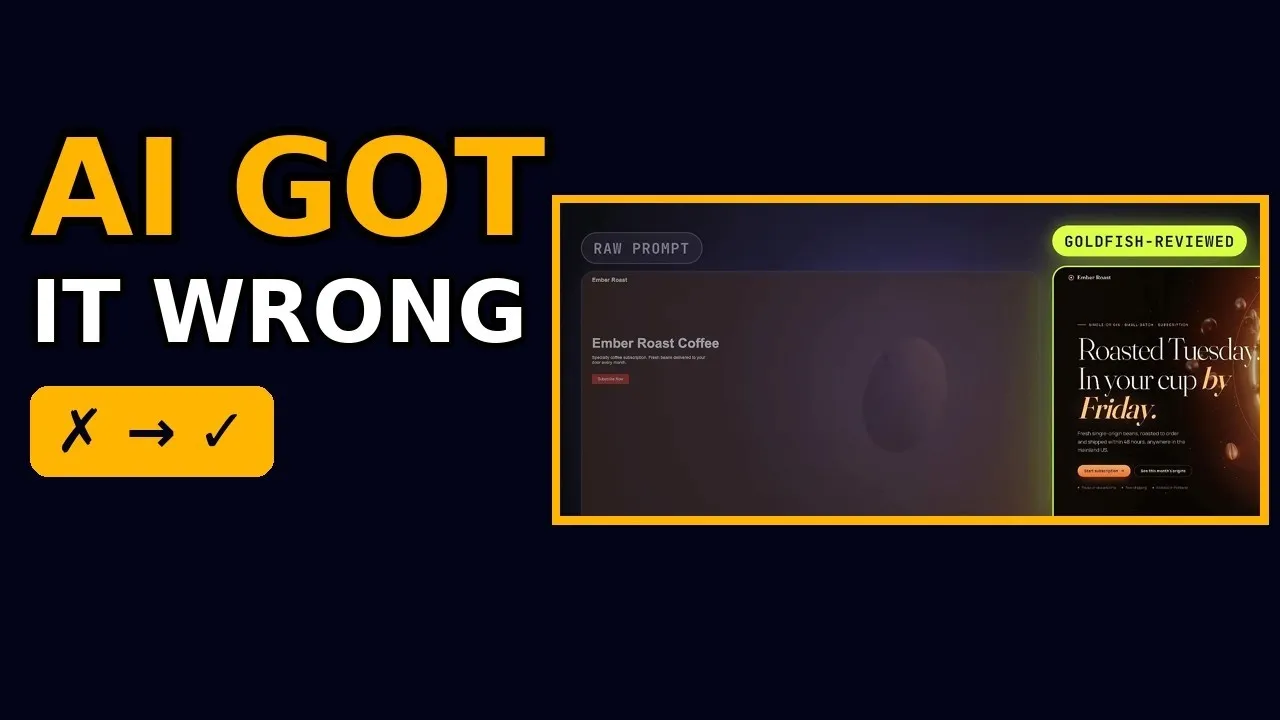
For a coffee subscription. The reviewers found that the signup buttons didn’t actually sign anyone up, that phones that can’t show 3D would see a blank space, and that the AI would have made up the plan details and FAQs.
Before: a brown screen with a flat spinning shape. After: a glowing cup with rising steam, floating beans and a headline you can read from across the room.
The goldfish don’t make a design smaller. They make it clearer.
2. An Instagram carousel
About five AI tools that save business owners 10 hours a week. The reviewers spotted a closing slide that made no sense on its own, text that would shrink to about nine pixels on a phone, and a guess stated as fact.
Before: eight slides of small text. After: a bright hook slide, a picture on every slide, simple steps and a clear closing slide.
3. Nine ad creatives
For a vitamin C serum. An extra “cold scroller” goldfish scored each ad out of 10 after a one-second look. The first nine looked like the same ad nine times and scored an average of 2 out of 10. After the review: 5.7 out of 10, nearly three times higher, from the same AI and the same product.
4. A 15-second promo video
For a fitness app. The review happens on the storyboard, before a single frame is made. Fixes: an unbacked claim became a question, a confusing calendar got one simple rule, and the coaching moment now shows cause and effect on screen.
5. A lead generation agent
It finds local businesses and writes outreach (shown with sample data). The reviewers found a rigged lead score, no memory of people who’d said “no thanks”, and a risk of the AI inventing facts. Now each business has a status, opt-outs drop off the list, and each sentence in a message points to where it came from.
How to set it up (two commands)
Open your terminal, the text window where you type commands to your computer. In Claude Code, type:
claude plugin marketplace add google/elephant-goldfish-model
claude plugin install egm@egm
Start a new Claude Code session and the skills are ready. If you use Codex, the commands are almost the same and are listed on the EGM page on GitHub (search “elephant-goldfish-model”).